You’ve chosen a web designer.
You’ve agreed on the project.
You’ve paid the deposit.
Now what?
For someone who doesn’t build websites for a living, the process can feel surprisingly mysterious.
What are you supposed to provide?
When do you see the design?
When does development start?
When can you make changes?
When does the website actually go live?
A good web design process should answer these questions before they become problems.
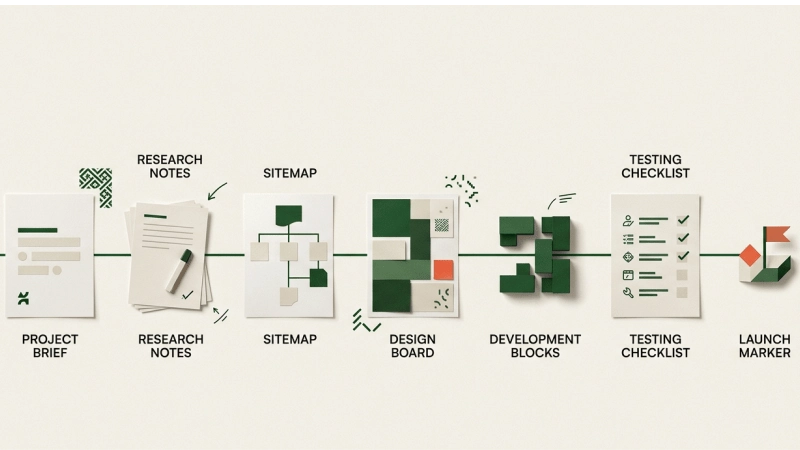
1. We start with the brief
Before anyone starts designing buttons, we need to understand the business.
What do you do?
Who are your customers?
What are you trying to achieve?
What isn’t working currently?
What should the new website do?
The better we understand the problem, the better the decisions become later.
2. We gather the materials
You’ll usually need to provide things such as:
- logo
- brand assets
- photography
- project images
- service information
- company information
- contact details
- testimonials
- existing content
Don’t worry if everything isn’t perfect.
Part of the process is figuring out what is missing.
3. We structure the website
Before designing individual pages, we decide what the website needs to contain.
This is where the sitemap and content structure come in.
For example:
Home → About → Services → Projects → Contact
A more complex business might need something considerably different.
The structure should follow the user’s journey—not simply copy another company’s navigation.
4. We design the experience
Now the website starts becoming visible.
We establish the visual direction, layout, typography, imagery and interactions.
But we’re not just making screenshots look nice.
We’re deciding how information should be presented and how people should move through the website.
5. Development begins
Once the design direction is established, the website gets built.
This is where the visual design becomes a functioning website.
Responsive behaviour, forms, interactions, content management, integrations and performance all become part of the work.
6. You review it
You shouldn’t discover what your website looks like on launch day.
There should be a review stage.
This is where you check the content, images, links, contact information and overall experience.
Good feedback is specific.
“Something feels wrong” is difficult to act on.
“This section should explain X before Y” gives us something useful to work with.
7. We test it
Before launch, the website needs to be tested.
Forms.
Links.
Mobile layouts.
Desktop layouts.
Navigation.
Images.
Performance.
Browser compatibility.
And all the little things that are easy to miss when you’ve been staring at the same page for three weeks.
8. We launch
Once everything is approved and ready, the website goes live.
The domain points to the new website.
Hosting is configured.
The final checks happen.
And suddenly the thing that existed on a staging URL becomes the actual public face of your business.
9. Then the website needs to live
Launching isn’t necessarily the end.
Depending on the project, you may need ongoing:
- content updates
- technical maintenance
- security updates
- performance monitoring
- SEO work
- new pages
- improvements based on analytics
A website is a business asset.
It shouldn’t be treated like a poster you print once and forget about.
The process should feel boring—in a good way
A good web project shouldn’t feel like constant chaos.
There should be a clear sequence.
You should know what we’re doing.
You should know what we need from you.
You should know when decisions need to be made.
And you should know what happens next.
That’s what a good process gives you.
Not more meetings.
More clarity.