If you’ve ever asked a web designer, “How much does a website cost?” you’ve probably received the most frustrating answer:
“It depends.”
And, annoyingly, that answer is correct.
A website can cost very little to put online—or it can become a serious investment. The difference usually isn’t the number of pages. It’s what the website needs to actually do.
A website isn’t a product with one fixed price
Think about it this way.
You can buy a chair for ₦20,000, or you can commission a carpenter to build one specifically for your space, using particular materials, dimensions and finishing.
Both are chairs.
They just aren’t the same thing.
Websites work much the same way.
A simple website built from an existing template can be relatively inexpensive. A custom website that requires strategy, copywriting, custom design, development, integrations, animations, a CMS and ongoing maintenance is a completely different project.
So instead of asking:
“How much is a website?”
A better question is:
“What does my website need to accomplish?”
That is where the real cost starts to become clear.
What are you actually paying for?
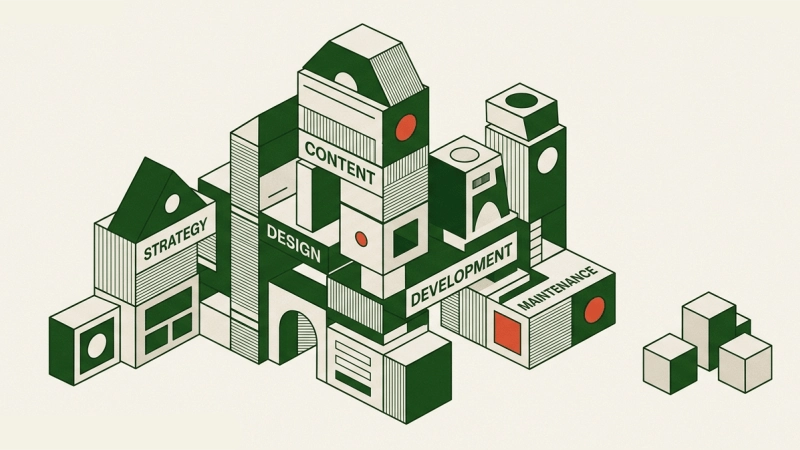
A professional website usually involves several different pieces of work.
1. Strategy
Before anyone starts designing buttons, someone needs to understand the business.
Who is the website for?
What does the visitor need to know?
What action should they take?
What makes the business different?
What pages are actually necessary?
Skipping this stage can produce a beautiful website that doesn’t do much for the business.
2. Content
Someone has to write the words.
Someone has to source or create the images.
Someone has to organise the information.
Sometimes the client provides everything. Sometimes the designer or agency handles it.
Content can have a surprisingly large impact on project cost because good content takes time.
3. Design
This is the part people usually think they’re paying for.
Layout. Typography. Colours. Images. Components. Mobile responsiveness. Interaction.
But there’s a big difference between adapting an existing template and designing a visual system specifically for a business.
Both can be valid approaches.
4. Development
A design still needs to become a functioning website.
Depending on the project, this could involve:
- Responsive development
- CMS setup
- Forms
- E-commerce
- Booking systems
- User accounts
- APIs
- Payments
- Databases
- Search
- Custom functionality
The more the website needs to do, the more development is involved.
5. Launch and maintenance
There’s also everything around the website itself.
Domain.
Hosting.
Analytics.
Security.
Backups.
Updates.
Technical support.
Some of these are recurring costs rather than part of the initial project.
So what’s a realistic budget?
There isn’t one universal price, but a useful way to think about website projects is by complexity.
A simple business website
A handful of pages, clear information, contact details and straightforward functionality.
This is usually where templates and lightweight systems make sense.
A professional marketing website
More intentional strategy, stronger design, custom sections, better content structure, responsive behaviour and potentially a CMS.
This is where many established businesses will find themselves.
A custom digital product
Memberships, dashboards, marketplaces, booking systems, e-commerce, complex integrations or other application-like functionality.
At this point, you’re no longer simply buying a website.
You’re commissioning software.
And the budget should reflect that.
Why do two designers quote completely different prices?
Because they’re often selling different things.
One person may be offering:
“I’ll customise this template and get you online.”
Another may be offering:
“We’ll research your audience, structure your content, create the visual direction, design the experience, develop the site and support the launch.”
Neither approach is automatically wrong.
The important thing is understanding what you’re actually buying.
A ₦300,000 website and a ₦3,000,000 website aren’t necessarily competing products.
Don’t pay for complexity you don’t need
This is important.
A bigger budget doesn’t automatically produce a better website.
If your business needs a simple five-page website that explains what you do and generates enquiries, you probably don’t need a custom web application.
Likewise, if your business needs customers to create accounts, make payments, manage orders and interact with your system, a cheap brochure website isn’t going to solve the problem.
The right budget is the one that matches the job.
The cheapest website can become the most expensive
Saving money upfront isn’t always saving money.
A poorly planned website can lead to:
- Rebuilding the design later
- Rewriting content
- Replacing unsuitable technology
- Losing leads
- Paying for unnecessary plugins
- Fixing technical problems
- Starting the project again with another developer
Sometimes the expensive part isn’t building the wrong website.
It’s building it twice.
So, what should you budget for?
Start with the business objective.
If the website is primarily there to establish credibility and generate enquiries, your requirements will be very different from a platform that processes thousands of transactions.
Define what the website needs to accomplish first.
Then decide how much of that needs to be custom.
Then choose the technology.
Not the other way around.
A good website isn’t necessarily the most expensive one.
It’s the one where the money spent is connected to a clear purpose.
And that’s probably the most useful answer to the question:
What does a good website actually cost?
Whatever it costs to build the right solution for the problem you’re trying to solve.