There is a surprisingly common mistake in web projects:
Someone asks for a website when what they actually need is an application.
Or they ask for a web app when a simple website would have done the job perfectly well.
The difference matters because the two solve very different problems.
Start with one simple question
Ask yourself:
Does my website mainly need to give people information, or does it need to let people do things?
If people mainly need to read, understand, trust and contact you, you’re probably looking at a website.
If people need to log in, create something, manage something, buy something, book something or interact with a system, you’re moving towards a web app.
What is a website?
A traditional website is primarily an information and communication tool.
For example:
- A company website
- A restaurant website
- A portfolio
- A consultancy website
- A school website
- A property company’s website
- A product landing page
Visitors arrive, browse information and take an action.
That action might be:
Call us.
Send an enquiry.
Book a consultation.
Visit our shop.
Read an article.
Buy a product.
The experience is generally centred around communicating something to the visitor.
What is a web app?
A web application is more like software that happens to run in a browser.
Think about things you use every day:
- Online banking
- Project management tools
- Customer portals
- Booking systems
- Learning platforms
- Marketplaces
- Dashboards
- Inventory systems
The user isn’t just reading information.
They’re interacting with a system.
They might create an account, enter information, upload files, make payments, manage records or collaborate with other users.
That’s fundamentally different from a marketing website.
Here’s a simple test
Imagine removing all the text and images from your idea.
What’s left?
If the answer is basically:
“People need to understand who we are and what we offer.”
You probably need a website.
If the answer is:
“People need to log in and use a system.”
You’re probably talking about a web app.
What if you need both?
This is actually very common.
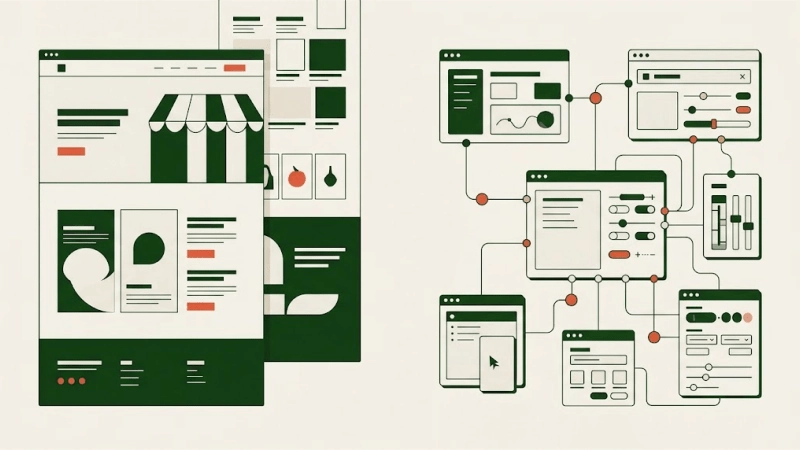
A business might have:
Website
Explains the company, services, products, team and values.
Web application
Allows customers to log in, place orders, manage subscriptions or access their account.
These can exist together.
For example:
yourcompany.com
could be the public-facing website.
And:
app.yourcompany.com
could be the customer application.
They serve different purposes, even though they’re part of the same digital ecosystem.
Why does the distinction matter?
Because the technology, budget and development process can be completely different.
A marketing website might need:
- Content management
- Responsive design
- Forms
- Analytics
- SEO
- Hosting
A web application might additionally require:
- Authentication
- User roles
- Databases
- Business logic
- APIs
- Payments
- Security
- Data management
- Notifications
- Testing
- Ongoing maintenance
That’s a much bigger engineering problem.
Don’t build an app because it sounds impressive
This is where businesses sometimes get carried away.
“Let’s build an app.”
Why?
“Because we’re going digital.”
That’s not really a requirement.
If your customers simply need to understand your services and contact you, building a complex application adds cost and maintenance without necessarily adding value.
Technology should serve the business.
Not the other way around.
Don’t build a website when you need software either
The opposite mistake can be even more frustrating.
Imagine trying to run an entire booking operation through contact forms and spreadsheets when customers actually need to select availability, make payments and manage reservations themselves.
At some point, the website stops being enough.
You need a system.
The middle ground
There is also plenty of territory between a basic website and a full-blown web application.
A website can include functionality such as:
- Online payments
- Appointment booking
- Product catalogues
- Forms
- Search
- Customer enquiries
- Newsletter subscriptions
That doesn’t automatically make it a web app.
The important question isn’t:
“Does my website have features?”
Almost every modern website does.
The question is:
“Is the website primarily communicating information, or is it operating a system?”
That distinction will get you much closer to the right solution.
Before you start building
Write down what you want a visitor to be able to do.
Not what you want the website to look like.
What should they actually be able to do?
If the answer is mostly reading, exploring and contacting you, start with a website.
If the answer involves accounts, transactions, workflows, data and repeated interactions, investigate a web app.
And if you’re somewhere in between, that’s okay.
That’s exactly what the planning stage is for.
Don’t choose the technology first. Define the problem first.
The right digital product becomes much easier to identify once you know what you’re actually trying to accomplish.